The Complexity Trap: A Simple System You Use Beats a Complex One You Don't
At some point, the business starts to feel complicated.
Not in a good way. Not the complexity of a growing team with interesting problems to solve. More like the complexity of too many moving parts that don't quite fit together. Too many tools. Too many processes. Too many offers. Too many things that require your attention before anything can move.
You added things to solve problems. And somehow, the problems are still there, just surrounded by more infrastructure.
This is the Complexity Trap™.
How It Happens
The Complexity Trap almost always starts with good intentions.
As the business grows, things start to slip through the gaps. So you add a tool to track it. Then another to communicate about it. Then, a process to make sure the tool gets used. Then, a meeting to check that the process is being followed.
Each addition makes sense in isolation. Each one was added to solve a real problem. But over time, the accumulation of tools, systems, and processes becomes its own problem—one that takes more time and energy to manage than the original gaps ever did.
The same thing happens with offers. A new service gets added to meet a client need. Then another to capture a different segment. Then a bundle. Then a VIP tier. Before long, there are six things being sold, each with different delivery requirements, different pricing conversations, and different drains on time and energy.
Complexity compounds quietly. And by the time it becomes visible, it's already everywhere.
What Complexity Actually Costs
The obvious cost of complexity is time. More tools mean more administration. More offers mean more mental overhead. More processes mean more things to manage, update, and train people on.
But the less obvious cost is the quality of decision-making. When systems are complicated, people don't use them. When there are too many offers, nobody is sure which one to lead with. When processes exist but aren't followed, work becomes inconsistent—and inconsistency is one of the biggest drains on a founder's time,because it creates exceptions that all need individual handling.
There's also the cost of adoption. A system that works perfectly on paper but requires significant discipline to maintain will, over time, be abandoned for whatever is faster and easier, which is usually the founder doing it themselves. Complexity, in this way, directly feeds the Founder Dependency Trap.
The Core Principle
There is a principle that cuts through most complexity decisions:
“A simple system used consistently beats a complex one that nobody touches.”
This sounds obvious. It almost never gets applied.
Founders consistently underestimate how much friction a system needs to add before people stop using it. The threshold is lower than you'd think. One extra step, one unclear owner, one part of the process that requires judgment rather than a rule—any of these is enough to cause the system to be quietly bypassed.
The best systems are the ones that are so straightforward that following them requires less effort than not following them.
The Iceberg Problem
One of the most common expressions of the Complexity Trap is what might be called the iceberg problem: founders invest heavily in tools (the visible part), while the underlying system (the invisible part) remains unclear.
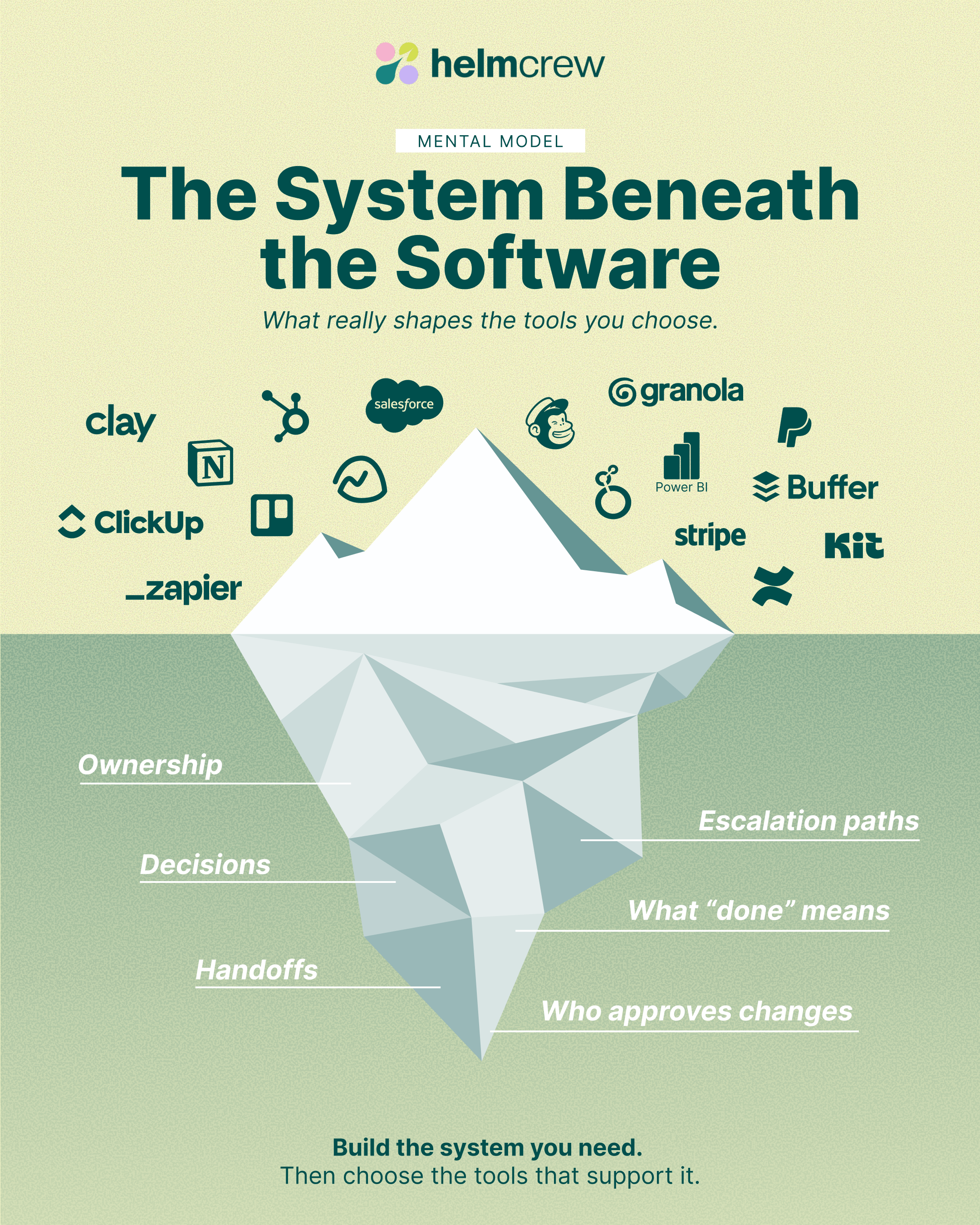
You can see the tools—ClickUp, Notion, Zapier, HubSpot, Slack, Stripe. What you can't see, unless you look deliberately, is whether there's clarity underneath them: who owns what, how decisions get made, what "done" means, how work gets handed off, and who can approve a change.
Tools without this underlying clarity don't create systems. They create organised chaos—everything is in one place, but nobody is quite sure what to do with it.
The question isn't which tools to use. It's what the system needs to do and then choosing the simplest tools that support it.
Getting Out of the Trap
The exit from the Complexity Trap usually involves two things that feel counterintuitive to founders who've built complexity as a response to problems: simplifying and removing.
→ On offers: most early-stage businesses have too many. The ones that drive most of the revenue are usually two or three. The others create work without creating enough return. Identifying the offer that should lead and structuring the business around it, is often the single most clarifying thing a founder can do.
→ On systems: the question to ask of every tool and process is "does this make the work easier, or does it just make me feel like I'm organised?" If the answer is the latter, it's adding complexity without adding value.
→ On decisions: a lot of complexity exists because there are no clear rules for how things should work. When every situation is handled case-by-case, every situation requires a decision. Building simple rules, even rough ones, eliminates the need to re-decide the same things repeatedly.
Simplicity isn't the absence of structure. It's structure that's clear enough that people can actually follow it.
The Complexity Trap is one of five predictable patterns that keep early-stage founders stuck. Understanding which one you're in changes what you need to do next.
→ Take the Founder Optionality Score™ to understand where your business is on the journey from founder-dependent to founder-optional.