The Founder Dependency Trap: What It Really Means When the Business Can't Run Without You
You built this business. Of course it depends on you.
That's not the problem. In the early stages, founder dependency is a feature. It's how things get done with limited resources, a limited team, and limited time. Your judgment, your relationships, and your energy are what make the business go.
The problem is when it stays that way.
When the business grows, but the dependency doesn't change. When you're doing more, earning more, hiring more—and somehow still holding the same number of things together personally. When a week off isn't actually a week off. When the team can execute, but only if you're available to unblock, decide, and correct.
That's the Founder Dependency Trap™. And it's where most early-stage businesses quietly get stuck.
The Three Constraints That Converge
Founder dependency isn't one problem. It's three constraints that compound on each other.
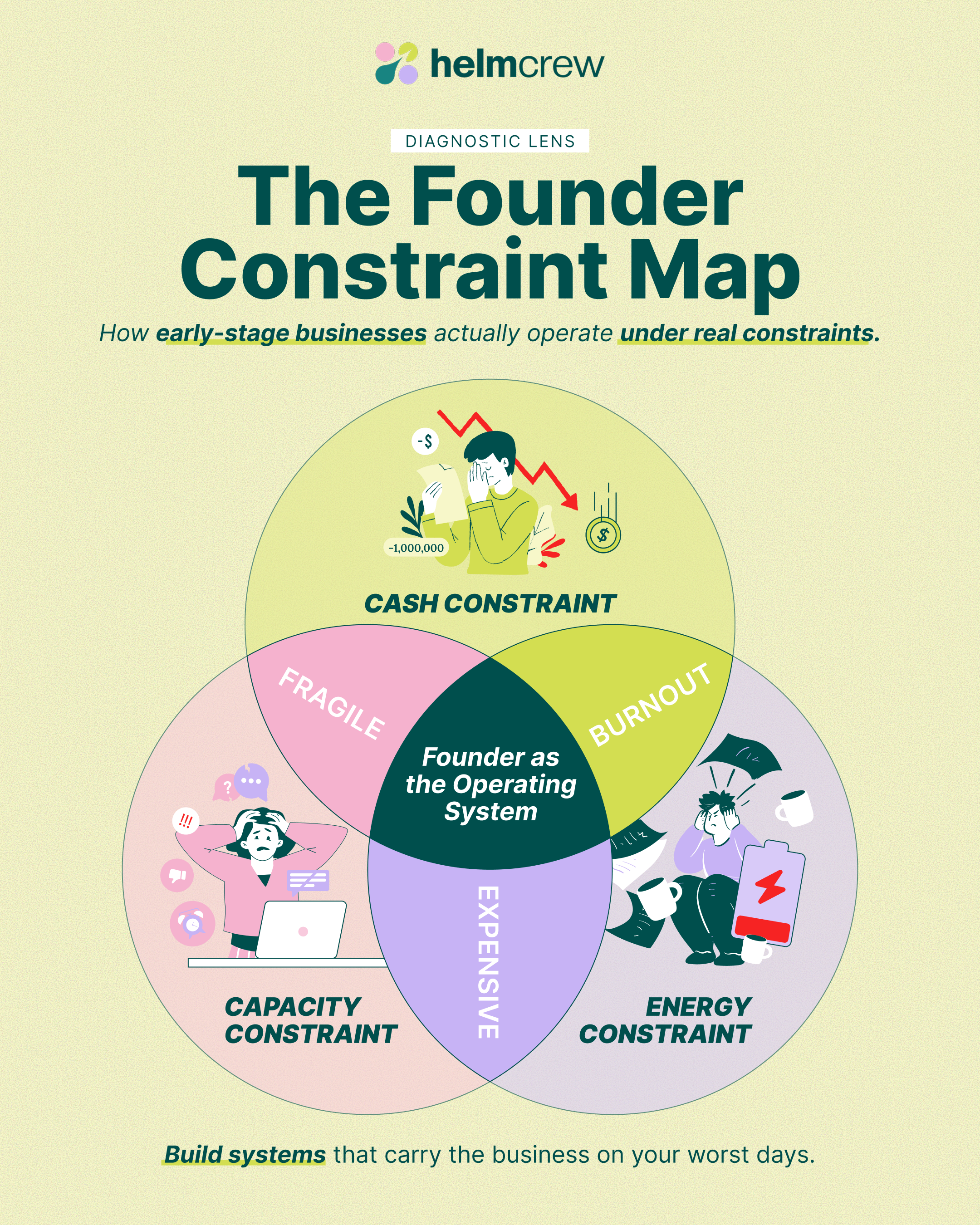
→ Cash constraint. The business's ability to invest in itself—in people, in systems, in capacity—is limited by what it generates. And because the founder is doing so much of the value delivery, revenue is essentially a function of the founder's available hours. Growth requires more founder time, which is already stretched.
→ Capacity constraint. There are only so many hours in a day. When the founder is the decision-maker, the executor, and the quality controller, capacity becomes the permanent ceiling. Delegation helps but only if the person you delegate to can actually operate without constant input.
→ Energy constraint. This is the one nobody talks about enough. Founders in the Dependency Trap aren't just stretched thin on time. They're making hundreds of micro-decisions a day, holding context across every part of the business, and carrying the weight of knowing that if they stop, things stop. That's a specific kind of exhaustion that sleep doesn't fix.
When all three constraints operate on the same person, the business becomes fragile. It works, but only just, and only because the founder is the thing holding it together.
What Dependency Actually Looks Like
Founder dependency expresses itself in different ways depending on the business, but some patterns are nearly universal:
→ Decisions wait for you. Not the big strategic ones—but all of them. Pricing exceptions, scheduling conflicts, how to handle a difficult client, what to say in a tricky email. If you're not available, things queue up until you are.
→ Handoffs break. Work moves between people or stages inconsistently. Context gets lost. Things fall through gaps. The only reliable fix is the founder stepping in to reconnect the pieces.
→ The business doesn't hold when you step back. Even for a week. Clients notice. The team notices. Things that were moving slow down, or stop, or require you to address them on your return.
→ Your role hasn't changed even as the business has grown. You're doing different things than you were in year one, but you're still in everything. Strategy, operations, relationships, delivery—your involvement hasn't decreased, it's just shifted.
Why Founders Stay Stuck in It
The dependency trap has a particular self-sustaining quality: it's very hard to step out of when you're inside it.
Delegation requires time to set up well—time that the founder doesn't have. Documentation requires stepping back from the work, which is hard when the work depends on you being in it. Hiring requires clear enough systems to onboard into—systems that don't yet exist because the founder is the system.
So founders do what they can. They hire, but the hire needs too much support to actually reduce the load. They document, but the documentation is incomplete and quickly out of date. They delegate, but check in so frequently that delegation becomes theatre.
None of this is failure. It's the natural result of trying to build structure while simultaneously being the structure.
The Way Out
Getting out of the Founder Dependency Trap is not primarily about hiring more or working less. It's about building the structures that allow other people—and eventually, systems—to carry what the founder is currently carrying.
→ That means clarity on ownership: who is responsible for what, and what authority do they actually have to act on it.
→ It means decision rules: clear enough guidelines that most situations can be handled without escalation, and explicit thresholds for when escalation is appropriate.
→ It means documented handoffs: not comprehensive SOPs for everything, but enough clarity about how work moves from one person or stage to the next that context doesn't get lost when the founder isn't there to provide it.
And underneath all of this, it means an offer structure that doesn't require the founder's direct involvement to deliver well. Because no amount of delegation can fix a business model in which the founder's presence is the product.
The goal isn't a business you're not involved in. It's a business that doesn't depend on you to function, so when you are involved, it's by choice.
The Founder Dependency Trap is one of five predictable patterns that keep early-stage founders stuck. Understanding which one you're in changes what you need to do next.
→ Take the Founder Optionality Score™ to understand where your business is on the journey from founder-dependent to founder-optional.