

OUR PHILOSOPHY
What we think about when we think about growth
You're at an inflection point.
The offer that worked, the funnel that converted, the way you've been running things—they got you here. But they won't get you further.
Not broken. Just not enough anymore.
And doing more of what you've been doing won't change that.
THE TRAPS
At a certain point, the strategies that built your business start to work against it.
The offer that converted stops converting as cleanly. The hustle that created momentum starts creating chaos. The systems you built for ten clients buckle under thirty.
This is when founders typically fall into one of five traps:
The Productivity Trap
Everything feels urgent. You're moving constantly, but nothing is compounding. Effort isn't the problem. Direction is.
The Optimisation Trap
You're adjusting, tweaking, and iterating. But the foundation underneath was never quite right, so the improvements don't stick.
The Visibility Trap
You're putting more out into the world. More content, more reach, more spend. But the funnel is leaking, so more in just means more lost.
The Complexity Trap
You built systems to create order. But the systems themselves have become the burden. Too many tools, too many processes, too much overhead.
The Founder Dependency Trap
You became the system. Everything runs through you. And as long as that's true, the business can only grow as far as you can personally carry it.
These aren't signs of failure. They're signs that the business has outgrown its current structure.


The goal was never to build a business that needs you.
It was to build one that doesn't need and depend on you, so you can choose to show up, instead of needing to.
This is the journey from Founder-Led to Founder-Optional. Not because every founder wants to exit. But because a business that depends entirely on you can't scale, can't survive your bad months, and can't become what you set out to build.
What Founder-Optional gives you isn't distance…it's choice.
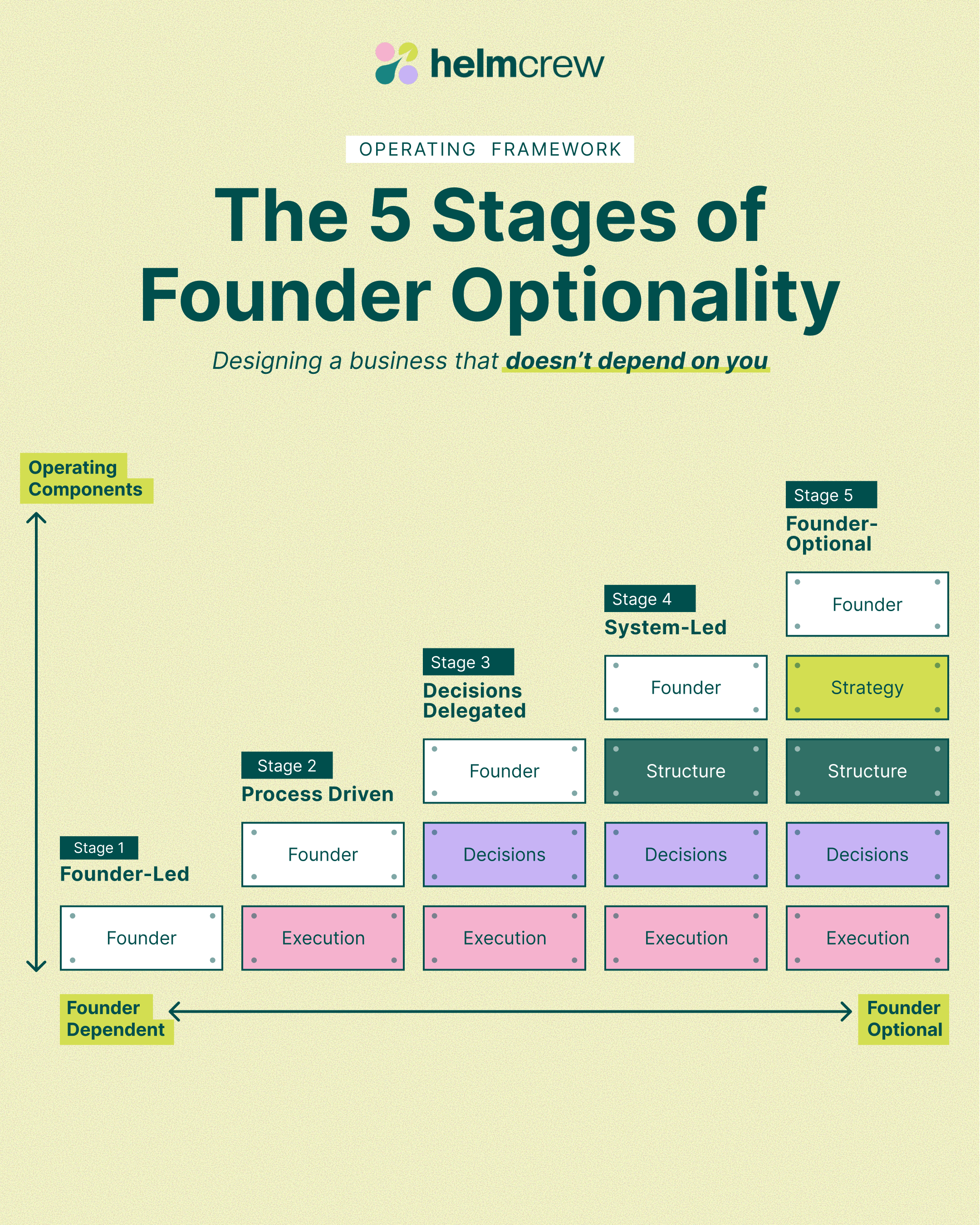

The structural problems don’t resolve themselves
More clients mean more dependency. More revenue means more complexity. More momentum means more of you are required to sustain it.
They multiply quietly until something forces a reset.
The founders who survive aren't always the most talented. They're the ones who stay in the game long enough to correct course. That requires a business that doesn't depend entirely on you to keep moving. Founder-optional isn't a luxury. It's how you stay in the game.
HOW WE SEE IT
The right diagnosis changes everything.
A founder can implement the best sales process in the world, but if the offer is misaligned, it won't save them. They can build sophisticated operations, but if the commercial foundation is leaking, better operations just make the leak harder to see.
We don't try to fix everything at once. We identify the weakest link. The one area acting as the real constraint on your next stage — and then fix that first.
Because a business doesn't move from Stage 1 to Stage 5 overnight. It moves one deliberate stage at a time.
This is why we look at every business through three lenses before we build anything.
⬇
The Three Lens Approach
-

1. Commercial Lens
How your business makes money, where revenue is created or lost, and whether the offer and funnel are structurally sound.
-

2. Operating Lens
How work flows, how decisions get made, and whether the current structure can carry the growth you're trying to create.
-

3. Founder Lens
Who you are, what you're building toward, and what kind of business fits the life you want. Because the structure for a founder building to sell looks different from one building to stay.